
The bottom line — In the Algarve, AC is no longer a luxury — it’s a 4-month-a-year necessity with peaks of 40°C+. But the wrong choice gets expensive: oversized = soaring bills, undersized = discomfort and premature wear. This guide helps you choose between wall-mounted single split, multi-split, cassette or ducted systems based on your home, usage and budget — with the price tiers and the mistakes to avoid.
Why the choice matters in the Algarve
The Algarve has very specific climate constraints:
- Summer: 35-42°C peaks, humidity 60-80% (coastal moisture), warm nights (25°C+)
- Winter: 8-15°C average, but homes often poorly insulated and cold in winter (“wind tunnel” effect)
- Tourist season: peak demand, expensive electricity, AC often running 12h+/day
➡️ Bottom line: your AC should be reversible (heat + cool), inverter (efficient), and rated for intensive use.
The 4 main families of air conditioning
🅰 Single wall-mounted split (1 indoor unit)
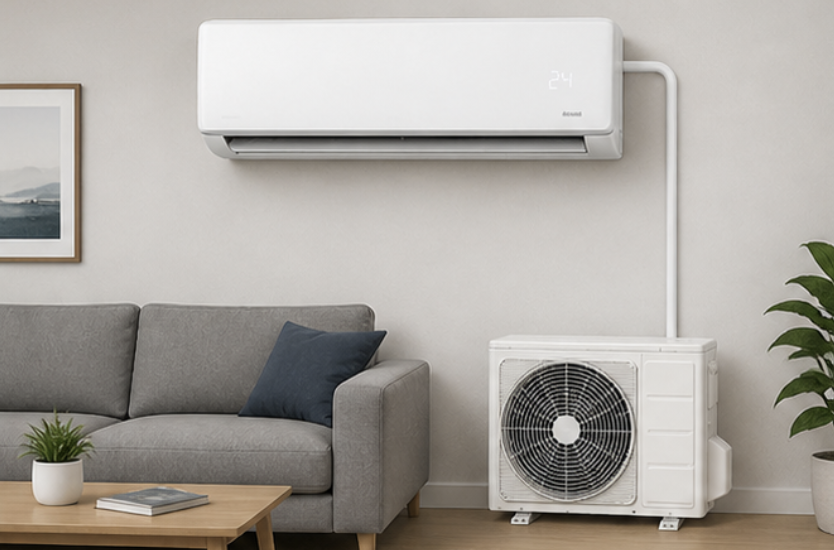
The most common setup: one outdoor unit + one wall-mounted indoor unit.
Best for
– Studios, 1-bed flats, open-plan 2-beds (single living space or master suite)
– Rooms 15-50 m²
– Tight budgets
Pros
– ✅ Lowest investment — 🥉 entry tier
– ✅ Quick install (3-4 hours)
– ✅ Excellent efficiency-to-price ratio on recent inverter models
Cons
– ❌ Only one room cooled
– ❌ Aesthetic not always discreet
🅱 Multi-split (1 outdoor + multiple indoor units)
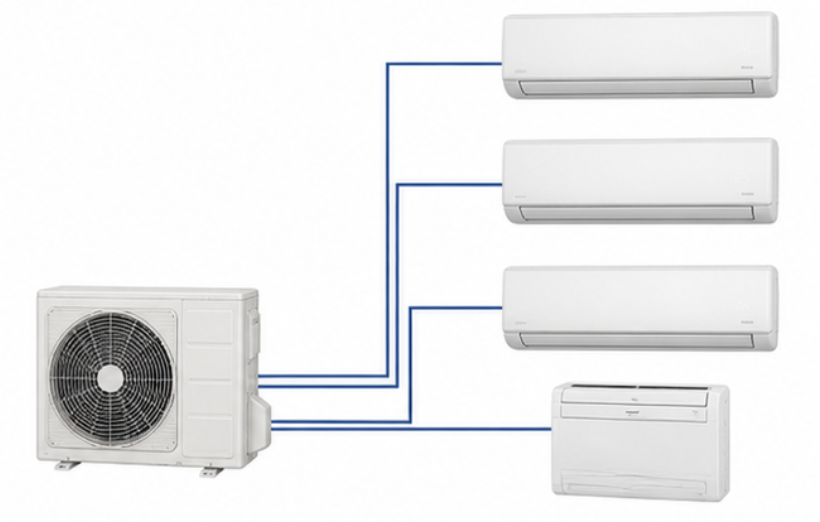
A single outdoor unit feeds 2 to 5 indoor units through refrigerant lines.
Best for
– 3-5 room flats
– Villas with multiple bedrooms + living area
– Cases where you want to avoid multiple outdoor units (aesthetics, condominium rules, limited terrace)
Pros
– ✅ Single outdoor unit (cleaner aesthetics, terraces stay clear)
– ✅ Independent room-by-room control
– ✅ Suits varied usage patterns (bedrooms at night, living area by day)
Cons
– ❌ More expensive than single split — 🥈 mid tier
– ❌ If the outdoor unit fails, everything stops
– ❌ All indoor units must be the same brand
🅲 Ceiling cassette (4-way recessed)
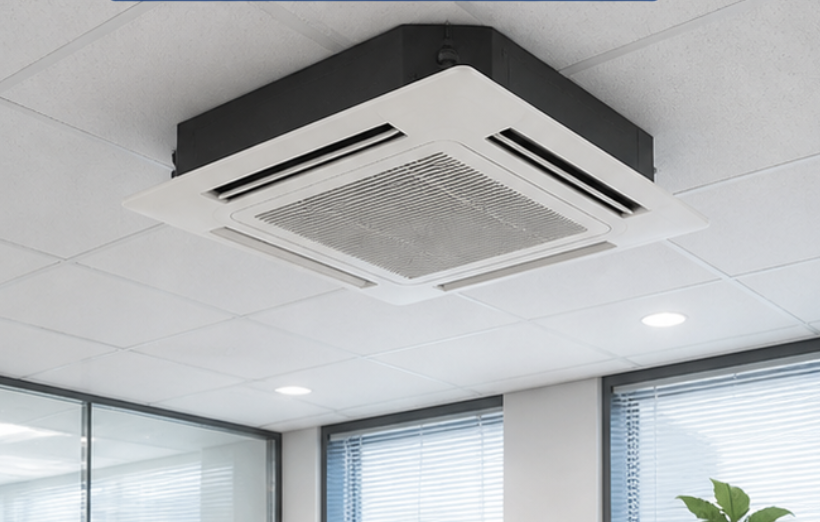
The indoor unit is flush-mounted in the suspended ceiling, blowing air in 4 directions.
Best for
– Large living rooms (50-100 m²)
– Offices and commercial spaces
– Homes with suspended ceilings or ability to install one
– Use cases where aesthetics matter (luxury rentals, premium AL)
Pros
– ✅ Even distribution (no “cold draught” on the neck)
– ✅ Very visually discreet (only the grille shows)
– ✅ Ideal for large open spaces
Cons
– ❌ Heavier installation works (suspended ceiling, ducts)
– ❌ More expensive — 🥈 mid / 🥇 high tier depending on setup
– ❌ Slightly more demanding filter maintenance
🅳 Ducted (centralised AC via ductwork)
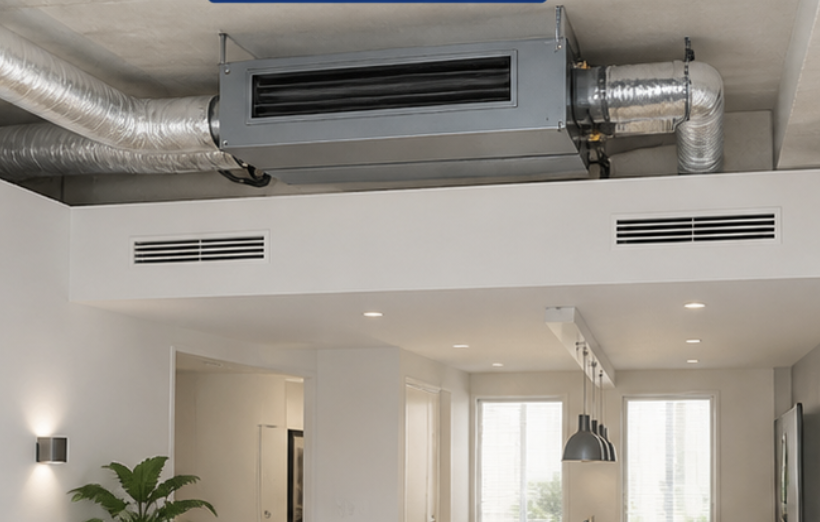
An indoor unit hidden in the loft or a cupboard, distributing air through a network of ducts to each room.
Best for
– Villas or houses with upper floors and lofts
– New builds or major renovations
– Seeking an invisible result (only outlet vents are visible)
Pros
– ✅ Most discreet and even solution
– ✅ Ideal for cooling the entire home uniformly
– ✅ Adds resale value
Cons
– ❌ Highest investment — 🥇 high tier
– ❌ Requires accessible loft or suspended ceiling
– ❌ Duct network maintenance every 5-7 years
– ❌ Retrofit installation = significant works
Comparison table — the 4 solutions
| Criterion | Wall split | Multi-split | Cassette | Ducted |
|---|---|---|---|---|
| Price tier | 🥉 Entry | 🥈 Mid | 🥈 Mid / 🥇 | 🥇 High-end |
| Aesthetics | Average | Good | Excellent | Excellent |
| Thermal comfort | Good | Good | Very good | Very good |
| Noise level | Variable | Good | Good | Very good |
| Maintenance | Simple | Simple | Medium | Heavier |
| Construction works | Light | Light/medium | Medium | Heavy |
| Best for | 1-2 bed / small room | 3-5 room flat / villa | Open space, premium AL | New villa / high-end |
💡 For 3-4 rooms, multiplying wall splits = several outdoor units (unappealing in the Algarve: terraces, condominiums).
💬 Exact pricing depends on your home, brand and installation constraints — request your CLIMEDGE quote, free within 24h.
Inverter or non-inverter: easy decision
Short answer: always pick inverter in 2026, except in unusual cases.
| Non-inverter (older) | Inverter (2026 standard) | |
|---|---|---|
| Operation | On/off | Continuous modulation |
| Energy use | Baseline | -30 to -50% lower |
| Comfort | Temperature swings | Stable |
| Noise | Loud cycling | Quiet |
| Price | -10-20% | Standard |
| Availability | Almost gone in new | 95% of market |
➡️ The inverter premium is paid back in 2 years through electricity savings.
Dedicated article coming soon: Inverter vs non-inverter: why it changes everything.
What capacity (BTU) to choose?
Simple rule of thumb in the Algarve:
| Room area | Recommended BTU |
|---|---|
| 10-15 m² | 9,000 BTU |
| 16-25 m² | 12,000 BTU |
| 26-40 m² | 18,000 BTU |
| 41-60 m² | 24,000 BTU |
| 60-90 m² | 30,000 BTU |
Add capacity if:
– +20% for South/West full-sun exposure
– +15% for poor insulation (single glazing, thin walls)
– +10% for 3+ regular occupants
– +25% for open kitchen (heat sources)
Dedicated article coming soon: How many BTU for my room?.
Recommended brands in 2026
What matters in the Algarve: reliability + local after-sales. The brands we install and recommend:
Top 1 — Daikin 🥇
- Proven reliability, 12-15 year lifespan
- Strong after-sales network in Portugal
- Premium price (+15-20%) but justified
Top 2 — Mitsubishi Electric 🥈
- Technical excellence, very low noise levels
- Average after-sales in Portugal
- Ideal for cassette and ducted systems
Top 3 — Fujitsu / Panasonic 🥉
- Excellent value for money
- Decent after-sales
- Safe choice for wall splits and multi-splits
Brands to consider
- LG: refined design, good efficiency, decent Portuguese after-sales
- Samsung: advanced WiFi tech, average reliability
- Toshiba: limited Portuguese presence, avoid without local support
Brands to avoid
- Imports without Portuguese after-sales network
- “Budget” generalist brands (Saivod, Becken, Beko in AC)
- Non-inverter models at any price point
Dedicated article coming soon: Daikin, Mitsubishi, Fujitsu, LG, Samsung: brand comparison for the Algarve.
4 typical use cases and our recommendations
Case A — Studio / 1-bed for summer rental (Albufeira, Lagos)
- Solution: wall split inverter 9,000-12,000 BTU
- Brand: Daikin Sensira or equivalent
- Tier: 🥉 entry — custom quote
- Why: robust, mixed guests, simple maintenance
Case B — 3-bed primary residence Faro
- Solution: multi-split inverter (1 outdoor + 3 indoor)
- Brand: Mitsubishi MSZ or Daikin
- Tier: 🥈 mid — custom quote
- Why: cost/comfort balance, independent room control
Case C — 4-5 bed villa primary residence Tavira
- Solution: ducted Daikin or premium multi-split
- Brand: Daikin Altherma + Mitsubishi
- Tier: 🥇 high-end — custom quote
- Why: even comfort, property value boost
Case D — High-end Alojamento Local with pool
- Solution: ceiling cassettes + multi-split bedrooms
- Brand: Mitsubishi Electric (silence + aesthetics)
- Tier: 🥇 high-end / bespoke — custom quote
- Why: differentiating selling point for Booking guests, design photos that convert
5 common mistakes to avoid
❌ 1. Oversizing “to cool down faster”
An oversized AC short-cycles (constantly switching on/off), wears out prematurely and dehumidifies poorly. Better to size correctly with inverter tech.
❌ 2. Buying at a hypermarket and finding an installer afterwards
Several issues: no installation warranty, gas sometimes poorly charged at factory for transport, brands often non-Tier-1.
❌ 3. Neglecting outdoor unit placement
Not in direct sun, not too close to neighbours’ windows (noise), not exposed to coastal salt spray (corrosion). Plan a wall bracket or anti-vibration feet.
❌ 4. Overlooking condensate drainage
An AC produces up to 2 L/h of water in humid summers. Poor drainage = stains on the façade, interior damage, unhappy neighbours.
❌ 5. Skipping maintenance
Clogged filters cause 15-20% efficiency loss and spread mould and bacteria. Clean every 2-3 months in season + annual professional service.
Dedicated article coming soon: AC maintenance in Portugal: what’s mandatory.
Frequently asked questions
Can AC really heat in winter in the Algarve?
Yes — all reversible inverter ACs heat efficiently down to 0-5°C outside temperature. In the Algarve, where winters rarely drop below 5°C, this is an excellent backup or even main heating solution for well-insulated homes.
How much does annual maintenance cost?
Pricing depends on the number of units, their accessibility and the service level you choose (annual visit, preventive contract, on-call repair). Our CLIMEDGE maintenance plans detail the 3 available formulas with custom pricing.
Do I need to declare the installation of an AC?
No, generally, installing a split AC requires no official declaration. However, in Portuguese condominiums, you must comply with internal rules (notably outdoor unit placement).
Can outdoor unit noise cause problems with neighbours?
A modern unit runs at 48-55 dB at 1 m (whisper-equivalent). But in the Algarve, narrow village streets and white-wall reverberation amplify the sound. Pick a quiet model (< 50 dB) and position it carefully.
What’s the lifespan of an AC?
10-15 years on average with regular maintenance, versus 7-8 years without. Premium models (Daikin, Mitsubishi) often reach 18-20 years.
Does AC use a lot of electricity?
A 12,000 BTU inverter AC uses about 1 kWh per running hour in moderate cooling mode. So ~€0.22/h in the Algarve. AC running 8h/day across 3 summer months = roughly €160 in annual extra cost.
Can I install AC myself?
No, except for plug-and-play portable units. A fixed split installation requires handling refrigerant gas (R32, R410A) → reserved for F-Gas certified installers. Without that certification, your installation is illegal and uninsured.
Next steps
If you’re planning an AC installation in the Algarve:
- Identify your use case among the 4 typical scenarios above
- Have your home measured by a certified installer (free visit)
- Get 2-3 detailed quotes (equipment + installation + first-year maintenance)
- Check F-Gas certification of the company (mandatory in Portugal)
- Prefer brands with local after-sales (Daikin, Mitsubishi, Fujitsu)
❄️ Request a CLIMEDGE quote — free site visit, detailed quote, equipment + installation + workmanship warranty on all our jobs.
Read further
- 📄 Inverter vs non-inverter: why it changes everything (coming soon)
- 📄 How many BTU for my room? (coming soon)
- 📄 Daikin, Mitsubishi, Fujitsu, LG, Samsung: brand comparison (coming soon)
- 📄 AC maintenance in Portugal: what’s mandatory (coming soon)
- 📄 Powering your AC with solar in the Algarve (coming soon)
About the author — Grégory FRANCHI runs CLIMEDGE, a company specialising in residential solar PV and air conditioning across the Algarve. F-Gas certified installations, Tier-1 brands, full warranties.
📧 info@climedge.pt — 🌐 climedge.pt